Probate Court Is Not About Fairness


When I first started researching probate court, I thought the case was about fairness.
Honestly, how could I not? Isn't justice supposed to be about treating people fairly? Isn't that what courts are for?
At least, that's what I thought.
Then I learned the hard way that probate court isn't really about fairness.
Two months after my mother passed away, my five siblings and I received a Notice of Trust Administration in the mail. Until then, none of us knew a trust even existed.
As we read through the documents, we learned that all six of us had been disinherited.
One brother inherited everything and became trustee.
At the time, I couldn't make sense of it. My mother had been diagnosed with end-stage renal disease about a month before signing her trust. In the months surrounding the trust and its amendment, she was treated for anxiety, depression, and memory problems.
So naturally, I kept coming back to the same question:
How is this fair?
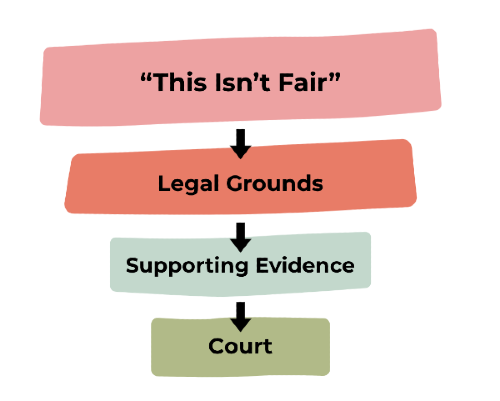
The answer surprised me. The court wasn't asking whether it was fair. The court was asking whether there were legal grounds to challenge the trust.
Those are two very different questions.
Don't get me wrong. I don't mean judges don't care about people or that they lack compassion. In fact, looking back, I think our judge cared deeply about making sure everyone had an opportunity to be heard.
What I mean is that judges cannot simply invalidate a trust because something feels unfair.
They need something more. . .
They need legal grounds. They need evidence. They need proof.
The Question I Was Asking Was Different Than the Question the Court Was Asking
Looking back, I realize I was asking one question while the court was asking another.
I kept wondering:
- How could this happen?
- Why would a parent disinherit six of her seven children?
- How is this fair?
Those were the questions consuming my thoughts. They felt like the most important questions in the world.
The court, however, was focused on something different. It wanted to know:
- What legal claim are you making?
- What evidence supports that claim?
- Can you prove it?
At first, that felt incredibly frustrating. It almost seemed like nobody was listening to what had happened. I wanted to tell the story. The court wanted to understand the legal basis for the challenge.
Over time, however, I began to understand why the system works this way. If courts decided cases solely on what seemed fair, two judges could look at the same facts and reach completely different conclusions. What feels fair to one person may feel unfair to another.
The law tries to create a more consistent standard. Not a perfect standard, but a standard. Rather than asking whether an outcome feels right or wrong, courts generally ask whether there is a legally recognized claim supported by evidence.
Fair and Legal Are Not Always the Same Thing
This was another hard lesson for me to learn.
For a long time, I assumed that if something felt unfair, there must be a way for the court to fix it. What I eventually learned is that fair and legal are not always the same thing.
Parents generally have the right to decide who inherits their property. They can leave unequal shares to their children. They can leave everything to one child. They can leave assets to a friend, caregiver, charity, or anyone else they choose.
The fact that family members are hurt by that decision does not automatically make a trust or will invalid.
That was difficult for me to accept.
At the same time, I learned the opposite can also be true. Just because a document exists does not automatically make it valid. A trust or will may still be challenged if there is evidence of undue influence, lack of capacity, fraud, or other legally recognized grounds.
That was the shift in thinking I had to make.
I had spent months asking whether the outcome was fair. The court was asking whether the law had been followed.
The court isn't deciding whether the outcome feels fair. The court is deciding whether there is evidence that something legally improper occurred.
Before I learned about legal grounds, I assumed that feeling something was wrong would be enough. It wasn't.
Watch: Feeling Suspicious Isn't Enough
The Shift That Changed Everything
Once I understood this, my entire approach changed.
nstead of focusing on how unfair the situation felt, I started focusing on what I could prove. Instead of going over the same questions in my head, I began gathering records and organizing evidence. I spent countless hours reviewing medical records and building timelines, learning about undue influence, understanding capacity, and figuring out which pieces of evidence supported which legal claims.
I learned that probate litigation is often less about what people believe happened and more about what they can demonstrate through facts and evidence.
That shift didn't make the situation hurt any less, but it gave me direction. For months I had been stuck in a cycle of frustration, confusion, and anger. Learning the legal framework gave me something productive to do. Instead of feeling powerless, I felt like I was finally moving forward.
I'm not saying courts done care about how you feel. I actually think courts understand that people are hurt. Many probate disputes involve families experiencing grief, betrayal, confusion, and loss. Judges see those emotions every day.
The problem is that feelings alone don't tell a judge what happened. They may point you toward a problem worth investigating, but they cannot establish what actually occurred.
Feelings may lead you to ask questions. Evidence helps you answer them.
What I Learned
Looking back, I don't think my feelings were wrong. The situation felt unfair because, from my perspective, it was unfair.
Those feelings were what pushed me to start asking questions in the first place. They motivated me to investigate, gather information, and try to understand what had happened. In many ways, they were the reason I began this journey at all.
But eventually I had to move beyond how I felt and learn how the court viewed the situation. I had to understand the difference between suspicion and evidence, frustration and proof, unfairness and legal grounds.
My feelings told me that something deserved a closer look. The evidence helped me explain why.
And that may be one of the most important lessons I learned throughout my entire probate journey.
Before You Move Forward
If you're reading this because something feels wrong about a trust or will, I understand. I've been there.
For a long time, I was focused on whether the situation felt fair. Looking back, I realize I was asking a different question than the court was asking.
- Do you have standing?
- Did you file on time?
- Do you have recognized legal grounds?
Those questions may sound technical, but they often determine whether a case moves forward long before a judge ever weighs the evidence.
If you're wondering whether what happened to you might actually be a probate case, start with the free quiz.
FREE QUIZ 👉 Do I Have a Probate Case?
The quiz will help you think through some of the same questions I had to learn the hard way, and you'll also receive my free Evidence Checklist.
Not ready for the quiz and want to learn more first?
My free course, Do I Belong in Probate Court?, explains how standing, deadlines, and legal grounds work together—and why many cases never make it past the starting line.
FREE Course 👉 Do I Belong in Probate Court?
Next week, I'll dive deeper into one of the first hurdles many people encounter: legal standing. What exactly is it, and why do so many cases get dismissed because of it?
Disclaimer: This article is for educational purposes only and does not constitute legal advice.